



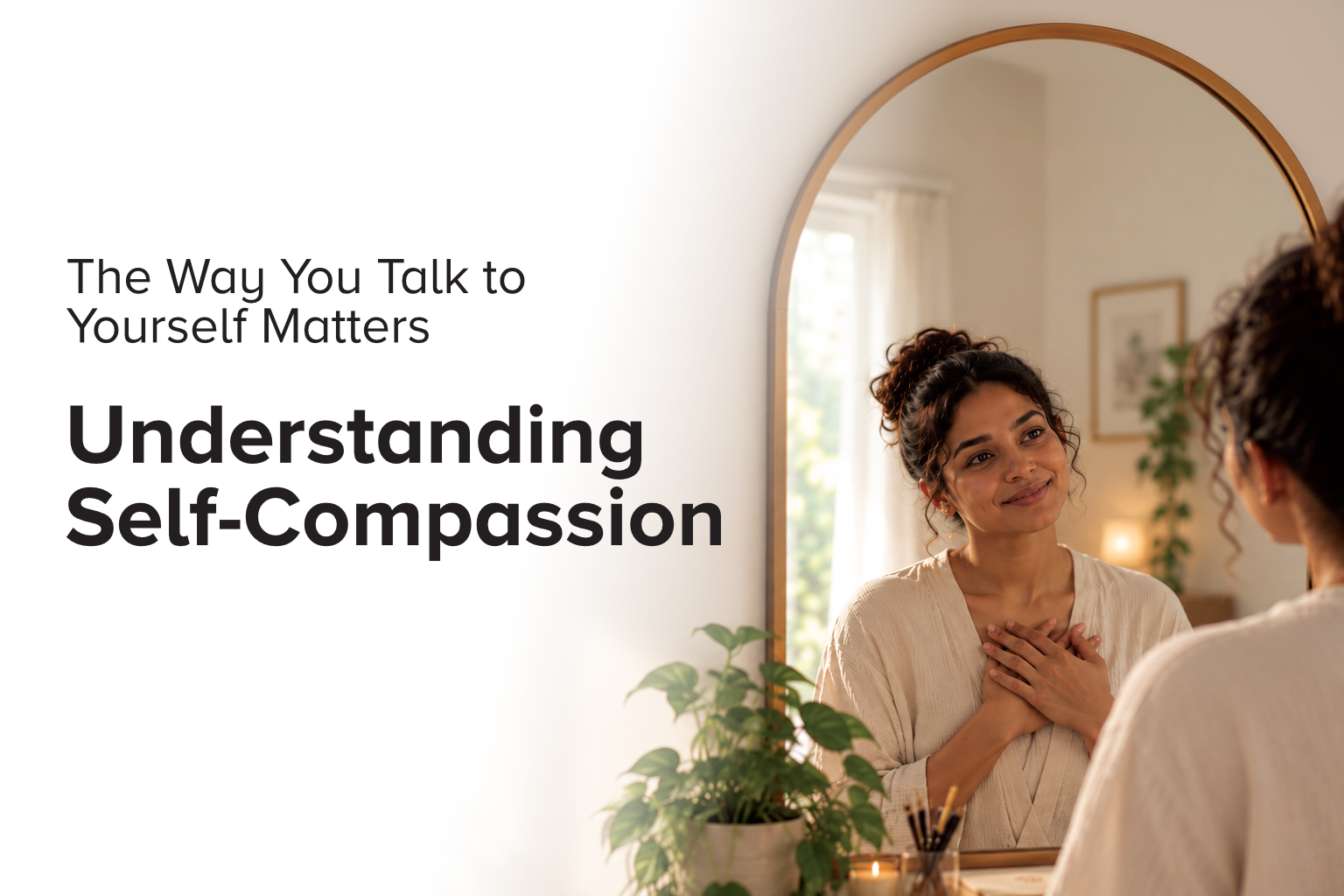
The Way You Talk to Yourself Matters: Understanding Self-Compassion
You know that voice in your head?
The one that shows up almost immediately after you make a mistake.
“Seriously? Again?”
“You should’ve known better.”
“How could you mess that up?”
Now imagine a friend comes to you with the exact same problem. They made a mistake, they feel terrible, and they’re already questioning themselves. Would you talk to them the way you talk to yourself?
Probably not.
You’d likely say something like, “Hey, it’s okay. You’re human. Don’t beat yourself up over it”
So why is it so much easier to offer understanding to someone else than to ourselves? That uncomfortable gap between how we treat others and how we treat ourselves is where self-compassion comes in.
So, What Exactly Is Self-Compassion?
Self-compassion is not about pretending everything is fine when it isn’t.
It’s not about ignoring your mistakes, avoiding responsibility, or convincing yourself that you’re amazing every time something goes wrong. It’s much simpler than that.
Self-compassion is choosing to stay on your own side when life gets difficult.
It might look like catching yourself in the middle of a self-critical spiral and changing the tone.
Instead of:
“I’m such a failure.”
You might say:
“Okay, that didn’t go the way I wanted. What can I learn from this?”
The situation hasn’t magically changed. You’re simply responding to yourself differently and that difference matters.
The Three Parts of Self-Compassion
Psychologist Kristin Neff, one of the leading researchers in the field of self-compassion, describes it through three core elements.
1. Self-Kindness
This is about treating yourself with the same warmth and understanding you would offer someone you care about.
Not:
“I always mess everything up.”
But:
“I made a mistake. I’m disappointed, but I can work through this.”
Self-kindness doesn’t mean letting yourself off the hook. It means correcting yourself without attacking yourself.
2. Common Humanity
Ever had a terrible day and thought, “Why am I the only one who can’t seem to get it together?”
That’s where common humanity comes in.
Everyone struggles. Everyone makes mistakes. Everyone feels insecure, overwhelmed, lost, jealous, embarrassed, or unsure sometimes. You’re not uniquely broken for finding something difficult. You’re human and remembering that can make difficult moments feel a little less lonely.
3. Mindfulness
Mindfulness means noticing what you’re feeling without immediately becoming consumed by it.
You can acknowledge:
“I’m really embarrassed right now.”
without turning it into:
“I’m embarrassing. Everyone probably thinks I’m incompetent.”
The first is an emotion. The second is a story your mind has built around it. Self-compassion gives you enough space to notice the difference.
What Self-Compassion Is Not
Sometimes self-compassion gets confused with being overly soft on yourself. It isn’t.
✓ It’s not self-pity.
Self-pity says, “Why does this always happen to me?”
Self-compassion says, “This hurts. I’m having a difficult time, and I can take care of myself while I work through it.”
✓ It’s not avoiding responsibility.
You can acknowledge that you made a mistake without deciding that you are the mistake. (Yep! Read that again)
In fact, when you aren’t busy defending yourself from your own criticism, it can become easier to look honestly at what went wrong.
You can take responsibility without drowning in shame.
✓ And it’s not weakness.
This one is worth sitting with.
Many of us grew up believing that being hard on ourselves was how we stayed motivated.
If I don’t push myself, I’ll become lazy.
If I’m not critical, I’ll stop improving.
If I give myself too much understanding, I’ll lower my standards.
But self-compassion doesn’t ask you to lower the bar. It asks you to stop beating yourself up when you miss it.
Why Being Kind to Yourself Can Actually Make You Stronger
Think about what happens after you make a mistake.
You replay it.
You criticize yourself.
You imagine what you should have done.
You feel worse.
Then, because you feel worse, you avoid thinking about it.
And now you’ve spent all that emotional energy without actually learning much from the experience.
Self-compassion interrupts that cycle. When you’re able to respond to yourself with understanding, you create more room to learn, adapt, and try again.
Research on self-compassion has linked it with several important aspects of psychological well-being, including:
- Less stress and burnout
Constant self-criticism can be exhausting. A kinder internal response can reduce the additional pressure we place on ourselves. - Greater resilience
Instead of staying stuck in “I failed,” you can move toward “That didn’t work. What now?” - Healthier motivation
Self-compassion doesn’t mean losing ambition. In many cases, it can help people recover from setbacks and keep going without relying entirely on shame as fuel. - Better emotional regulation
When you stop treating every uncomfortable emotion as something that needs to be fixed immediately, you create more space to respond rather than react. - Healthier relationships
The way we relate to ourselves often influences how we relate to other people. When we become less defensive and less critical internally, it can become easier to extend that same understanding outward.
But If Self-Compassion Helps So Much, Why Does It Feel So Unnatural?
Because for many people, self-criticism is familiar.
At some point, you may have learned that being hard on yourself was a way to stay disciplined, successful, or “better.”
So when you try to be kinder, your brain might immediately respond:
“Am I just making excuses?”
“Shouldn’t I be pushing myself harder?”
“If I let myself off this easily, what will stop me from doing it again?”
And then there’s the inner critic.
It might be harsh, but it’s familiar. This familiarity can feel safe, even when it isn’t actually helpful.
For some people, perfectionism adds another layer.
If your sense of worth has become connected to getting things right, self-compassion can feel almost like lowering your standards.
But it isn’t. You can still have high standards. You can still want to grow. You can still hold yourself accountable. The difference is that you no longer have to use shame as your primary source of motivation.
And sometimes, the reason self-compassion feels difficult is much simpler:
No one ever taught you how.
You’re trying to develop a completely different relationship with yourself, and that takes practice.
Start Smaller Than You Think
You don’t need to wake up tomorrow and suddenly love everything about yourself.
Start with one difficult moment.
Maybe you send an email with a mistake in it.
Maybe you say something awkward in a meeting.
Maybe you lose your patience with someone you care about.
Maybe you look at everyone else’s achievements and suddenly feel like you’re falling behind.
Notice what you say to yourself.
Then pause.
Not for a dramatic five-minute mindfulness exercise.
Just long enough to interrupt the automatic response.
Instead of:
“What is wrong with me?”
Try:
“That didn’t go well.”
Instead of:
“I always do this.”
Try:
“I’m disappointed in myself right now.”
And then:
“What can I do next?”
That’s self-compassion.
Not forced positivity, not pretending you didn’t mess up, not telling yourself everything happens for a reason. Just choosing a response that helps you move forward instead of keeping you stuck.
You Don’t Have to Be Your Own Enemy
Life is going to give you plenty of opportunities to criticise yourself.
You’ll make mistakes.
You’ll disappoint yourself.
You’ll compare yourself to someone else.
You’ll have days when you don’t feel particularly confident, productive, patient, or put together.
That’s part of being human.
The question is not whether you’ll struggle.
It’s what happens inside you when you do.
How do you bounce back? How do you reconnect with yourself? How do you choose to relate to yourself when you’re disappointed?
Self-compassion doesn’t make difficult moments disappear.
It gives you a different place to stand while you move through them.
You don’t have to become a completely different person.
You don’t have to stop wanting more for yourself.
You don’t even have to like every part of yourself.
You can simply learn to stop abandoning yourself when things get hard.
Because sometimes, the person who needs your kindness the most…
is you.
Written by:
Shilpa Rajendra
Counselling Psychologist