



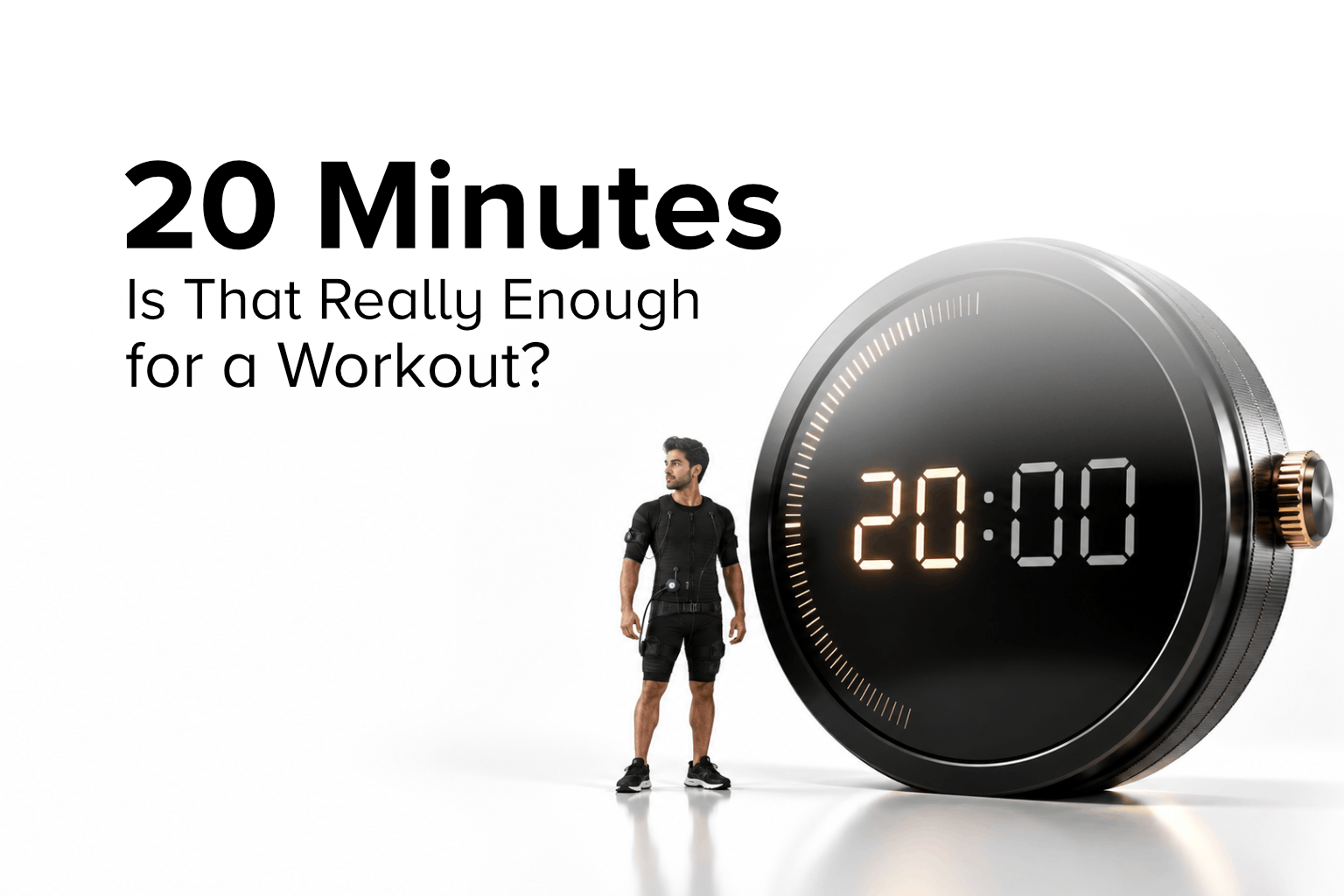
That is probably the first question many of us ask when we hear about Whole-Body Electro Muscle Stimulation (WB-EMS).
We are used to thinking that an effective workout needs 45 minutes, an hour, or even longer. Traditional training often involves warming up, performing several exercises, resting between sets, and moving from one exercise to another.
WB-EMS approaches training differently.
Instead of relying only on voluntary muscle contractions, WB-EMS uses controlled electrical impulses delivered through electrodes positioned over major muscle groups. While the stimulation is applied, we perform simple, controlled movements under professional supervision.
So, why is a typical WB-EMS session around 20 minutes? To understand that, we need to look at what is actually happening during those 20 minutes.
What Is WB-EMS?
WB-EMS stands for Whole-Body Electro Muscle Stimulation.
During a session, specially positioned electrodes deliver electrical impulses to selected muscle groups. These impulses stimulate motor nerves, which can cause the targeted muscles to contract. At the same time, we perform controlled movements and exercises.
This creates a training environment in which external electrical stimulation and voluntary exercise are combined. The objective is not simply to make our muscles contract. The goal is to use the stimulation in a controlled and individualised way as part of a structured training session.
Why Can the Session Be So Short?
The answer starts with how many muscles can be involved at the same time.
In conventional resistance training, exercises are often organised into sets. For example, we might perform an exercise primarily targeting the legs, rest, then move to an upper-body exercise, and later perform core exercises.
WB-EMS can stimulate several muscle regions simultaneously. Depending on the equipment setup and training protocol, stimulation can be applied to areas such as:
- Chest
- Lower back
- Upper back
- Mid back
- Abdominal muscles
- Glutes
- Thighs
- Arms
This does not mean that every muscle is receiving exactly the same stimulation or producing the same amount of force. The intensity and response depend on electrode placement, individual anatomy, exercise technique, training status, and the settings selected by the trainer.
The important point is that multiple muscle groups can be addressed within the same session. That is one of the reasons WB-EMS can be used as a time-efficient training method.
Why Doesn’t a Short Workout Mean an Easy Workout?
Workout duration and workout intensity are not the same thing. A 20-minute session can be physically demanding when multiple muscle groups are being stimulated simultaneously and we are performing controlled exercises.
Think of it this way:
The goal of WB-EMS is not to make our workout longer. It is to make the available training time more focused and efficient.
However, 20 minutes should never be interpreted as a universal guarantee that everyone will receive the same training effect. Our training responses vary from person to person.
What Makes WB-EMS Different From Conventional Training?
Conventional resistance training primarily depends on voluntary muscle activation. We decide to move a weight, our nervous system sends signals to our muscles, and the muscles contract to produce movement.
WB-EMS adds another component: electrical stimulation of motor nerves.
This means the training stimulus is created through a combination of voluntary movement and electrical muscle stimulation. Instead, WB-EMS can be viewed as a specialised, time-efficient training modality.
Why Is 20 Minutes Attractive to Us Today?
One of the biggest challenges in modern fitness is not always a lack of knowledge. It is consistency. We often have:
- Busy work schedules
- Family responsibilities
- Long commuting times
- Irregular routines
- Limited time for exercise
For many of us, the idea of spending an hour or more in a gym can become another barrier to maintaining a regular exercise routine. A shorter, structured session can make exercise feel more manageable. And when a training method fits more easily into our routine, consistency may become easier to achieve.
But 20 Minutes Is Not a Magic Number
It is important to understand this clearly. There is nothing magical about the number 20.
The duration of a WB-EMS session is based on the characteristics of the training method, stimulation protocol, exercise selection, our individual condition, and recovery considerations. The objective is not to finish exactly 20 minutes because longer is impossible. The objective is to deliver an appropriate training stimulus within a controlled and time-efficient session. The correct approach always depends on the individual and the protocol being used.
At Longefit, Time-Efficient Training Means Making Your Time Count
At Longefit, the concept of time-efficient training is built around a simple idea: Your fitness routine should work with your lifestyle rather than against it.
WB-EMS provides an opportunity to train multiple muscle groups in a short, structured session while receiving professional guidance. But technology alone isn’t enough.
A meaningful training experience requires the right technology, the right protocol, the right intensity, the right exercise, professional supervision, and consistency. That is where the trainer becomes an important part of the process.
So, Is 20 Minutes Really Enough for a Workout?
It can be enough for a structured WB-EMS training session because the method allows electrical stimulation to be combined with controlled voluntary exercise and can address multiple muscle groups simultaneously. But the number 20 should not be treated as a promise of identical results for everyone.
Effective training is not simply about how long we exercise. It is about what we do, how we do it, how appropriately it is prescribed, and whether we can do it consistently and safely. In a world where time is one of the biggest barriers to exercise, WB-EMS offers a different approach: less time spent on the workout does not have to mean less thought put into the workout.
The goal is not to spend more time exercising. The goal is to make the time we have more purposeful.
Written by:
Shekeer Hussain VK
Training and Standardisation Lead